
EmphaSIze April 2026: Sensory Integration in Autism and ADHD
By Sensory Integration Education, 8th April 2026
Welcome to the April issue of EmphaSIze! It’s Neurodiversity Celebration Week next week - so this month we're celebrating Neurodiversity from a Sensory-Informed Perspective.
In this issue we've put together useful articles, research, books, and product ideas to help better inform ourselves about neurodiversity so that we can put into practice actions to be more inclusive in our settings when working with clients.
Also if you’re looking to take the next step in your sensory training journey, applications for Module A of our Postgraduate Pathway are still open until 5pm on Friday 20th March. And if you identify as neurodivergent and want to find out what support you can expect if starting your postgraduate journey with us, read the article below ‘How We Help Neurodivergent and Disabled Postgraduate Students Thrive’ to find out more!
News & Features
My PGCert in Sensory Integration: The Journey That Unlocked My Autistic Identity
Starting a postgraduate qualification often feels like a step forward in your career—but sometimes, it opens doors you never expected. In her blog, Senior OT and Sensory Integration Practitioner Hannah Ross shares how what began as a professional development opportunity became a deeply personal journey of self-discovery.
Through studying for her SIE Postgraduate Certificate in Sensory Integration and learning more about sensory processing, she not only found new ways to support her clients but also a language and framework that helped her finally understand herself.
Read more about Hannah's inspiring journey.
The Sensory Side of Autism
Autism is often understood through the lens of communication and social interaction but this perspective only tells part of the story. In her latest blog, Dr Lelanie Brewer explores the vital role that sensory processing plays in shaping how autistic individuals experience and engage with the world.
Drawing on research and clinical insight, this blog highlights how differences in sensory modulation, discrimination and motor coordination are not secondary features, but core aspects of autism. By deepening our understanding of these sensory experiences, we can begin to create more responsive, supportive environments that enable autistic individuals to thrive.
Volunteers Needed – Investigating Autistic Individuals’ Opinions About a Sensory Tool
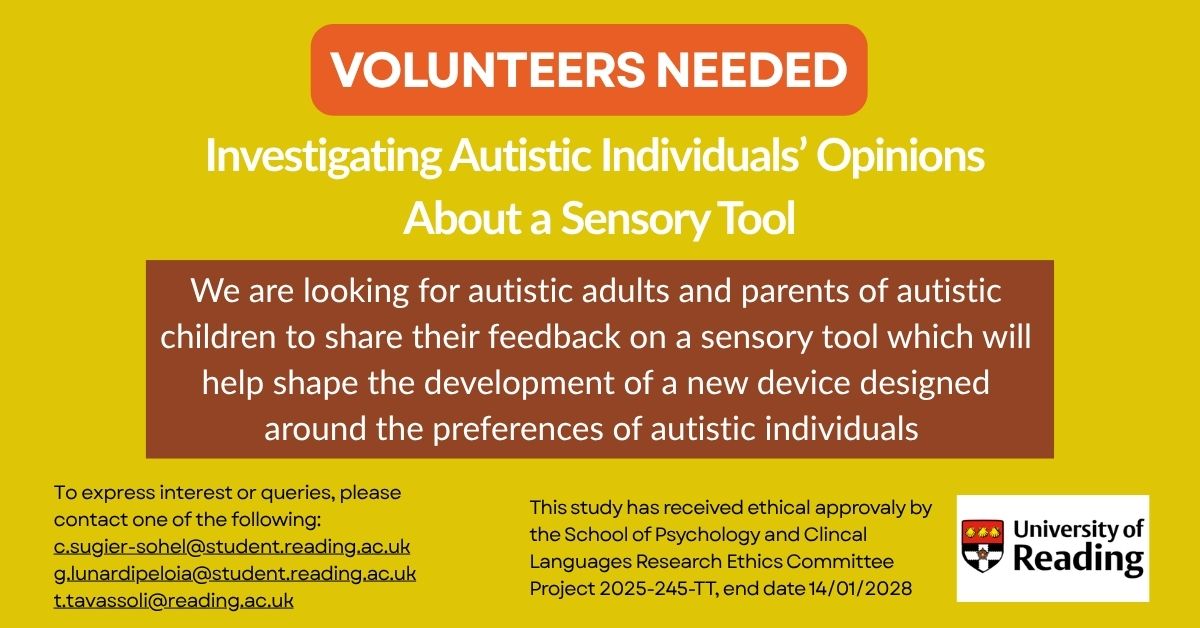
Researchers at the University of Reading want to hear from autistic adults and the parents and family carers of autistic children of primary school age who are interested in taking part in a study that will help to develop a sensory tool to support relaxation for autistic people who may experience sensory-related stress.
Participants will be invited to visit the university for a face-to-face interview lasting up to one hour where they will be shown two sensory tools and asked to explore and discuss what they think about them. They will receive a £25 Amazon voucher as compensation for their time.
Participating in this study will contribute to the development of a sensory tool aimed at supporting relaxation for autistic individuals who may experience sensory-related stress.
If you know anyone who may be interested in taking part or have any questions, email Charlotte Sugier-Sohel at: [email protected].
Also see:
Autistic people seem to feel joy differently – here’s what it can tell us about neurodivergence
Why many autistic girls are overlooked
UK-first sensory pod improves experience for neurodivergent travellers at East Midlands Airport
How to support an autistic person through grief
Brilliance in Motion: How Autistic Students Navigate Unpredictable School Environments
What Is Autism? Early Signs and What It Looks Like in Girls
Why Neurodivergent Women Are Quietly Leaving the Workforce and What HR Is Missing
Upcoming Courses and Webinars

We have a number of live webinars that take place throughout the year covering a broad range of SI-related topics. Below is a snapshot of webinars happening in the first few months of 2026 or click here to view a summary of all the upcoming live events.
All these webinars are available to you by signing up to our Lifelong Learning Programme or can be purchased as individual courses:
- Advancing Sensory-based OT Through Play, Relationship and Embodiment – 15 April 2026
- Sensory Integration and Deafness – 29 April 2026
- Neurodivergence and the Perimenopause – 12 May 2026
- PANS/PANDA and Sensory Processing - 21 May 2026
- Cortical Visual Impairment and Sensory Integration – 15 June 2026
SI Research Digest
Below are links to the most popular sensory integration and sensory processing research papers and findings published on our social channels last month:
This new study found that anxiety in autistic adolescents may be influenced more by how they interpret their body’s signals than how accurately they detect them. Distressing beliefs about these signals were strongly linked to anxiety.
Review and Developmental Model: Early Childhood Emotion Regulation and Co-Regulation in Autism
This new paper breaks down what we do and still don’t know about how young children with autism navigate emotions, and how parents support them along the way.
It introduces a fresh framework showing how autism-specific challenges can affect parent-child emotional interactions, sometimes making it harder to build coping strategies together.
This perspective could shape future research and improve clinical support for families
This new study investigated links between sensory processing, autism severity, and maternal caregiver burden in 73 autistic young children (aged 3–6) compared with 73 age- and gender-matched typically developing peers. Sensory processing difficulties were reported in 77% of the autistic children in the study. Mothers in the autism group showed significantly higher levels of depression, anxiety, and caregiver burden. Sensory processing differences that impacted on everyday life (sensory difficulties) associated with greater caregiver burden and vestibular and visual processing differences in particular were significant predictors of caregiver burden.
A new study (n=795; ages 4–17) examined the mechanisms underlying Extreme Demand Avoidance (EDA) across autistic and neurotypical populations.
Findings indicate that anxiety and autism traits are positively associated with EDA behaviours across all groups. Notably, sensory reactivity, specifically sensory sensitivity and sensory seeking, uniquely characterised EDA in the autism + PDA group. In contrast, intolerance of uncertainty was associated with EDA only in neurotypical children, and not in autistic children without PDA.
These results suggest that heightened sensory reactivity may be a key mechanism underpinning demand avoidance in PDA, with implications for developing targeted, strengths-based and sensory-informed intervention approaches.
Relationship Between Motor Skills and Receptive Language in Children with Autism Spectrum Disorder
This new study explored the link between motor skills and receptive communication in young autistic children. Researchers assessed 21 children aged 3–6 and found strong, significant connections between both gross and fine motor skills and the ability to understand language, with gross motor skills showing the strongest relationship.
Sensory Processing Informed Autism Practice for Child-centred Therapists
This new paper explains how sensory differences and chronic dysregulation affect autistic children and highlights the need for flexible, child-centred therapy that respects autistic sensory experiences. The authors suggest five sensory-informed therapy adaptations: 1) adjusting the environment, 2) communication style, 3) emotional understanding, 4)body awareness, and 5)emotional vocabulary to reduce dysregulation and support meaningful, respectful therapeutic relationships.
Resources
Take a look at our books and product recommendations for this month:
AuDHD: Blooming Differently: Written by Leanne Maskell who was diagnosed with ADHD at 25 but only learnt she was autistic 7 years later, this book chronicles her turbulent journey—from a childhood of vulnerability and trauma to a high-achieving model and lawyer, outwardly successful but inwardly struggling.
The book exposes the relentless burnout of not understanding your brain and the power of self-awareness in finally thriving. More than just a memoir, the book offers practical insights for AuDHD individuals and those who support them—essential for psychiatrists, educators, and anyone seeking to understand neurodivergence. With lived experience and professional expertise, AuDHD: Blooming Differently is an honest and transformative guide to rewriting the neurodivergent narrative.
AuDHD: The System That Holds: A Lead Guide to Living with Autism and ADHD as an Adult: Living with both Autism (ASD) and ADHD can feel confusing, exhausting and deeply lonely. You may look capable on the outside while quietly falling apart underneath. You may keep pushing, keep masking, keep trying to hold everything together - only to end the day overwhelmed, shut down, burned out, and wondering why everything seems harder for you than it does for everyone else.
This book was written for the adult who is tired of blaming themselves. It will help them understand how Autism and ADHD collide in real life and why that collision can lead to overload, time blindness, emotional spikes, executive dysfunction, and the constant feeling that they are somehow failing at things that should be simple. The book is a clear, compassionate guide for adults who want language for their experience, relief from constant self-doubt, and practical support they can actually use.
Autism, Identity and Me: A Practical Workbook and Professional Guide to Empower Autistic Children and Young People Aged 10+: This empowering workbook will help children and young people to develop a positive understanding of their autistic identity. Highly structured and visual, the workbook is broken down into key sections such as 'Interests and focus', 'Masking', 'Emotions and energy levels' and 'My autistic identity statement' to create a personal passport and to develop a deeper understanding of what autism means to the young person as an individual. Content has been shaped by autistic advisors and contributors, with first-hand experiences of young people woven throughout.
Sensory Explorers: Book 1 in the Sensory Explorers Series: This is the first book in a series that serves as a perfect starting point for helping children build self-awareness, confidence, and a sense of adventure in their own sensory world. Young readers are invited to join Cypress, Scout, and a group of curious characters as they discover how their body and brain work together to help them understand the world and develop a stronger sense of themselves. Together, they explore the Seven Super Senses that help us see, hear, smell, taste, touch, move, and know where our bodies are in space.
With a special introduction to the tactile (touch), proprioceptive (body awareness), and vestibular (movement and balance) systems, this engaging story helps children begin to understand why they might seek certain sensations, avoid others, or sometimes feel overwhelmed by their environment.
Wobble Cushion – Junior: This is a round inflatable cushion, strong enough to sit or stand on. The cushion is designed to improve posture and promote ‘active sitting’, which allows the child a small amount of movement to improve focus and engagement. It can also be used to stand on to build core strength and practice balance. When a child sits on the Wobble Cushion, they will instantly become unstable (i.e., they will wobble!) and are encouraged to engage their back and core muscles. The wobble effect makes sensory seeking users focus on how they sit, reducing fidgeting and helping to improve focus on the task in hand.
Scooter Board: This scooter board is ideal for autistic children or teens or those with sensory and vestibular challenges. Children can sit, kneel or lie prone position on the sturdy 40.5cm long board. The integral contoured handles help children grip the Scooter Board to aid stability and balance, helping inspire confident movement. The board is also good for heavy floor work, helping to strengthen the hands and wrists and having a positive impact on fine motor skills such as writing and dressing.
Discounts & Special Offers

Please quote DISCOUNT CODE SIE20 for 10% discount on Southpaw orders up to £100. Orders must be placed by phone on +44 (0) 115 718 0020.
Would you like to receive EmphaSIze: The Sensory Integration Newsletter in your inbox? JOIN SIE FREE TODAY
Best wishes,
Sensory Integration Education
NB: Sensory Integration Education is not responsible for the content on external websites. Sharing a resource does not imply endorsement by Sensory Integration Education.
