
-

(G141) Sensory Integration and Burnout in ADHD
Course5.0 average rating (2 reviews)Summer CPD Booster – access from 1 to 31 August only!
-
%20Postural%20Control%20and%20Reflexes%20in%20Sensory%20Integration%20%E2%80%93%203%20Mar%202026%20(4).png)
(G142) Postural Control and Reflexes in Sensory Integration
CourseSummer CPD Booster – access from 1 to 31 August only!
-
%20Viewing%20Eating%20and%20Drinking%20Through%20a%20Sensory%20Lens%20%E2%80%93%2023%20Mar%202026%20(1).png)
(G148) Viewing Eating and Drinking Through a Sensory Lens
Course5.0 average rating (2 reviews)Summer CPD Booster – access from 1 to 31 August only!
Masking in Neurodivergent Children and Young People: The Impact on Mental Health and Externalising Behaviour
By Dr Lelanie Brewer, 28 January 2026
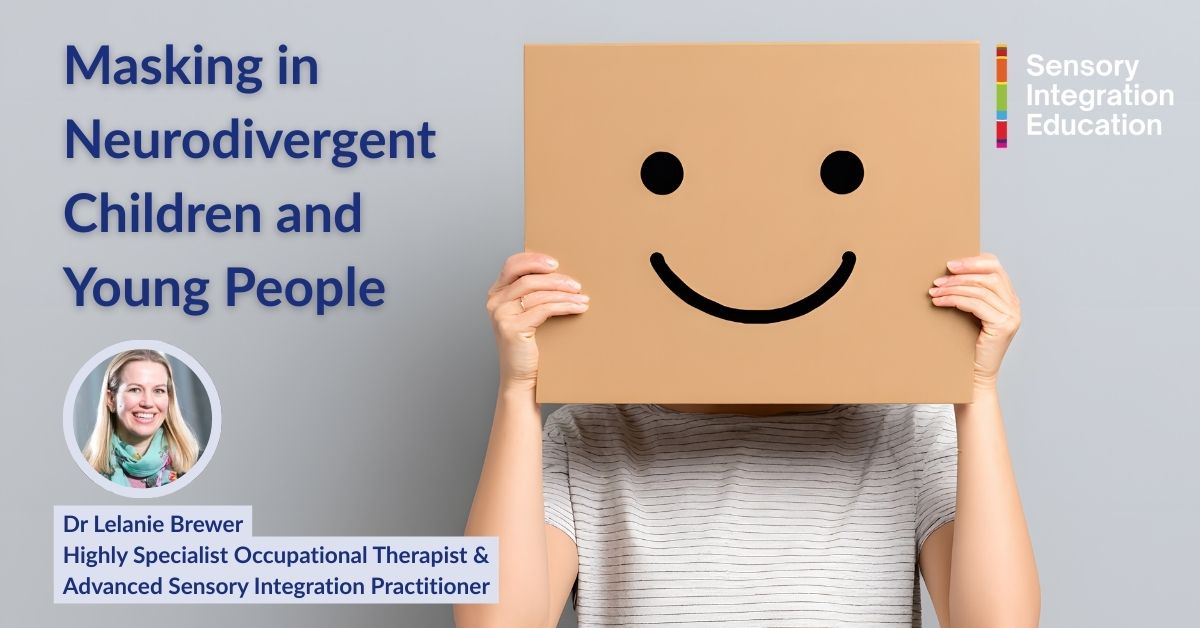
Over the past decade, masking, also known as camouflaging, has emerged as a central construct in understanding the lived experience of many neurodivergent children and young people, particularly those who are autistic and/or with ADHD. While originally conceptualised in autism research, masking is increasingly recognised across neurodevelopmental profiles, including for children and young people with sensory processing differences
From a clinical perspective, masking is not merely a behavioural phenomenon. It is a cognitive, emotional and physiological strategy that can have significant implications for mental health, presentation and risk. Critically, it can also obscure clinical need and contribute to the misinterpretation of externalising behaviours.
What is Masking?
Masking refers to the effortful suppression, modification, or compensation of neurodivergent traits in order to conform to social expectations or avoid negative consequences. This may include:
- Suppressing stimming or sensory-seeking behaviours
- Consciously monitoring and modulating eye contact, tone, or facial expression
- Imitating peers’ social behaviour (“social scripting”)
- Inhibiting movement or restlessness despite internal dysregulation
- Concealing confusion or distress to avoid standing out
- Over-relying on cognitive strategies to navigate social situations
Masking can be partly conscious (deliberate effort to “fit in”) and partly automatic, shaped by repeated social feedback. Importantly, masking is often most pronounced in structured environments such as school, where social and behavioural expectations are explicit and persistent.
The Cognitive and Emotional Load of Masking
Clinically, masking should be understood as a high-load process. It requires continuous self-monitoring, inhibition and cognitive control. Over time, this can lead to:
1. Heightened Anxiety and Hypervigilance
Many children or young people who mask operate in a state of chronic social vigilance, monitoring their behaviour, anticipating judgment, and attempting to pre-empt mistakes. This can manifest as generalised anxiety, social anxiety, or perfectionistic tendencies.
2. Reduced Self-Concept Clarity
When a child consistently suppresses their authentic responses, they may develop a fragmented or negative self-concept, internalising the belief that their natural way of being is unacceptable.
3. Emotional Exhaustion and Burnout
Sustained masking is associated with emotional depletion, reduced resilience, and, in some cases, autistic burnout or broader psychological burnout. Clinically, this may present as withdrawal, irritability, school avoidance, or loss of motivation.
4. Somatic and Physiological Stress
Masking is not purely psychological; it is associated with sustained sympathetic arousal. You may see links to sleep difficulties, somatic complaints, or heightened sensory sensitivity.
From Internalising Strain to Externalising Behaviour
A critical clinical consideration is the relationship between masking and externalising behaviours.
Many children successfully mask in high-demand environments (e.g., school), containing or inhibiting distress. However, once the child reaches a perceived “safe” environment (often home), the accumulated stress can overwhelm regulatory capacity. This may manifest as:
- Post-school meltdowns or shutdowns
- Irritability, low frustration tolerance, or emotional volatility
- Aggression toward siblings or peers
- Defiance or task refusal (e.g., homework avoidance)
- Prolonged dysregulation following minor triggers
From a behavioural perspective, this can be misinterpreted as oppositionality, poor parenting, or inconsistent behaviour. From a neurodevelopmental perspective, it is better conceptualised as delayed stress discharge or capacity exceedance.
Conversely, in some cases, masking may collapse within the school setting when demands outstrip capacity, resulting in classroom outbursts, disruptive behaviour, or impulsive acts. These behaviours may be misattributed to conduct problems rather than underlying neurodevelopmental stress.
Implications for Practice
Rather than focusing solely on reducing externalising behaviour, clinicians should aim to:
- Reduce environmental demands that drive masking
- Build regulation capacity (sensory, emotional, cognitive)
- Support safe “unmasking” spaces
- Enhance adult understanding of neurodivergent needs
- Promote self-advocacy and emotional literacy
It is also important to work collaboratively with schools and to encourage them to:
- Normalise movement and sensory regulation
- Allow flexible communication styles
- Provide predictable routines
- Recognise that “coping in school” does not negate need
- Share information about post-school functioning
Clinicians should support parents or carers to:
- Anticipate post-school decompression
- Prioritise co-regulation over correction
- Reduce unnecessary evening demands
- Advocate collaboratively with schools
Conclusion
Masking is a clinically significant phenomenon with profound implications for mental health and behaviour in neurodivergent children. It can obscure need, delay identification, and contribute to both internalising and externalising difficulties.
By integrating an understanding of masking into assessment, formulation, and intervention, clinicians can move beyond surface-level behaviour to address underlying stress, support authentic functioning, and ultimately improve physical and mental health outcomes for children and families.
Dr Lelanie Brewer
Highly Specialist Occupational Therapist, Advanced Sensory Integration Practitioner, PhD, MScOT, BSc, FHEA
References:
Sensory Integration Education is a leading UK provider of postgraduate and CPD training in sensory integration. Our postgraduate courses are accredited by Sheffield Hallam University.
Check Out Our Upcoming Live Training Events
You can purchase individual events or get access to a whole year of CPD events with a Lifelong Learning Programme subscription.
