
EmphaSIze February 2026: Mental Health and Sensory Needs
By Sensory Integration Education, 2nd February 2026
Welcome to the February issue of EmphaSIze where this month we're focusing on Mental Health and Sensory Needs!
Everyday activities can often be challenging or unpleasant for individuals with sensory processing differences and this can impact their mental health. Many studies show clear links between mental health and sensory processing sensitivities.
As it’s Children’s Mental Health Week next week, in this month’s newsletter, you'll find useful information, articles, books and product ideas that look at supporting children’s mental health and sensory needs.
Also we’re currently accepting applications for our next cohort of students! So if you’re considering further study or reflecting on your own SI journey, be sure to read the inspiring article written by Tanya Oliver, winner of the 2025 Dr Greg Kelly Outstanding MSc Student Award.
News & Features
Reflections on my MSc Journey in Sensory Integration 
In this reflective article, Tanya Oliver—2025 winner of the Dr Greg Kelly Award for Outstanding MSc Student of the Year—shares her journey through the MSc in Advancing Practice in Sensory Integration and the impact it has had on her professional growth.
Drawing on her experience as an Occupational Therapist in the NHS and mainstream education, Tanya explores how the course deepened her understanding of sensory processing, strengthened her clinical confidence, and enhanced her ability to support neurodivergent individuals.
The article reflects a journey of learning, research and inspiration that has shaped her future aspirations, including pursuing a doctoral degree.
Read more about Tanya’s journey here.
If you’re considering further study or reflecting on your own SI journey, applications for our next cohort of students are now open! Find out more here.
Through a Sensory Lens: How Sensory Processing Differences Affect Children’s Daily Lives
This blog explores how sensory processing differences shape children’s everyday experiences, influencing how they feel, learn, socialise and cope with the world around them. Through a sensory lens, it highlights common ways these differences may present—such as sensitivities to noise, touch, movement, or light—and explains how they can impact emotional regulation, learning, relationships, mental health and self-esteem.
Masking in Neurodivergent Children and Young People: The Impact on Mental Health and Externalising Behaviour
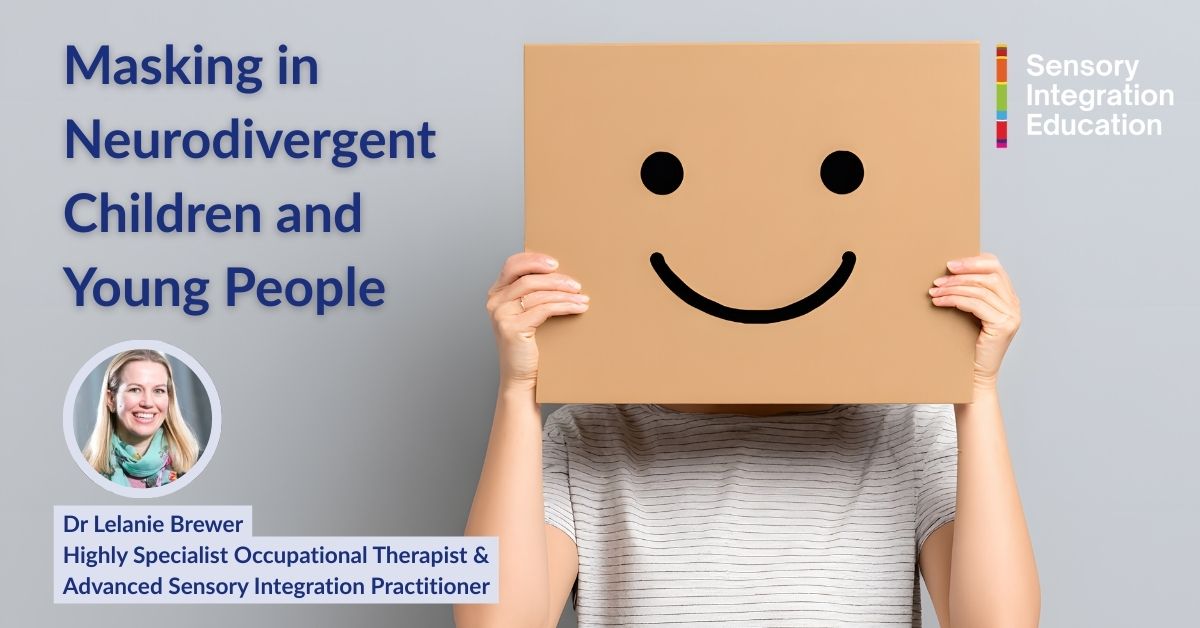
In her latest blog, Dr Lelanie Brewer explores masking (or camouflaging) as a clinically significant and often overlooked experience for neurodivergent children and young people, including those who are autistic, have ADHD or sensory processing differences.
Crucially, the blog highlights how the hidden strain of masking can later emerge as externalising behaviours such as meltdowns, aggression, or defiance, which are frequently misinterpreted without a neurodevelopmental lens.
Also see:
Sensory trolley to help patients at South Cumbrian hospital’s emergency department
Lessons for employers on the neuroscience of neurodiversity
Great Minds Together launches Sensory Pod to enhance services for neurodivergent people
'Hairdresser incredible with my autistic son'
Inverclyde Leisure hosts sensory family ice skating sessions
Upcoming Courses and Webinars

We have a number of live webinars that take place throughout the year covering a broad range of SI-related topics. Below is a snapshot of webinars happening in the first few months of 2026 or click here to view a summary of all the upcoming live events.
All these webinars are available to you by signing up to our Lifelong Learning Programme or can be purchased as individual courses:
Ø Embodied Reasoning for Paediatric Occupational Therapists – 6 February 2026
Ø Sensory Integration and Burnout in ADHD – 18 February 2026
Ø (Sensory Spotlight Talk) Postural Control and Reflexes in Sensory Integration – 3 March 2026
Ø Viewing Eating and Drinking Through a Sensory Lens – 23 March 2026
Ø Advancing Sensory-based OT Through Play, Relationship and Embodiment – 15 April 2026
Ø Sensory Integration and Deafness – 29 April 2026
SI Research Digest
Below are links to the most popular sensory integration and sensory processing research papers and findings published on our social channels last month:
This new study examined facial expression recognition in autistic individuals in relation to the alexithymia hypothesis, which proposes that difficulties recognising others’ emotions stem from challenges in understanding one’s own emotional states. The findings consistently did not support this hypothesis. Instead, emotion recognition difficulties were more strongly associated with autistic traits, particularly social communication differences, than with co-occurring alexithymia.
Neuro-cortical Signatures of Attention in Uni- and Multi-sensory Audio-visual Processing in Children
This new study examined the impact of attention on sensory-evoked cortical responses within the visual (occipital), auditory (temporal), and parietal cortices during multisensory audiovisual stimulation. Findings revealed attention-related differences in sensory processing among typically developing children aged 9–14 years. Children with shorter attention experienced more difficulties in sensory-related tasks and took longer to process visual and auditory information.
This new study explored self-esteem as a key factor linking physical activity (PA) and subjective well-being, with enjoyment of PA influencing this relationship. It also examined how motor difficulties affect these associations. The findings suggest that motor difficulties play a significant role, as individuals with greater motor challenges experienced fewer well-being benefits from time spent in physical activity.
Decoding the Neural Basis of Sensory Phenotypes in Autism
This new study investigated how sensory phenotypes in 146 autistic children and adolescents relate to differences in resting-state functional connectivity. The researchers drew on data from the Province of Ontario Neurodevelopmental Network (POND), which included both resting-state fMRI scans and Short Sensory Profile scores. The researchers found that many sensory phenotypes in autism can be statistically distinguished based on functional connectivity.
The study explored how anxiety, self-efficacy, resilience, and movement variability influence perceptions and actions in adults with and without Development Coordination Disorder (DCD), confirming the significant role of movement variability in the movement behaviour of adults with DCD.
Resources
Take a look at our books and product recommendations for this month:
The Mental Health and Wellbeing of Children and Young People with Learning Difficulties: By demystifying terms such as mental health, wellbeing, learning difficulties and the sensitivities surrounding labels, this practical and evidence-based guide helps you achieve an in-depth understanding of the children and young people you work with. It provides skills and knowledge for supporting their mental health and wellbeing in educational settings - from nursery to secondary school in both mainstream and specialist environments with talking and non-verbal communication approaches to accommodate varying needs.
The Kids' Guide to Staying Awesome and In Control: Packed with easy-to-use ideas to regulate emotions and senses, this book will help kids aged 7+ process difficult feelings so that they feel awesome and in control. The book is all about helping young people understand their feelings and learning tools to handle them such as everyday calming tricks (e.g., bubble breaths, pressure holds, or finger pulls-perfect for anywhere, anytime) and longer body breaks using moves such as the cross-crawl or the superman pose.
You Shine, Amazing Boy: A Collection of Inspiring Stories about Courage, Kindness, and Self-Confidence: This book brings together ten powerful short stories that inspire boys to lead with heart, make good choices, and grow from every challenge. Each story follows a relatable hero as he learns about honesty, teamwork, friendship, gratitude, and standing up for what’s right. Ideal for boys ages 7–10 and perfect for bedtime or independent reading.
Learning Resources Big Feelings Pineapple: For children aged 3 years+, this pineapple feels a lot of feelings and helps children identify and express emotions through creative play with mix-and-match face pieces. It also supports preschool social-emotional learning (SEL) development by encouraging children to identify and talk about different facial expressions with every face they make. The pieces are the perfect size for children developing their fine motor skills as they slot them into the holes.
Magnetic Sensory Balls: The tactile interaction with these magnetic balls helps improve fine motor skills and hand-eye coordination. The bright colour schemes are not just visually appealing, but they also help boost focus and concentration and the unique textures offer a satisfying sensory experience, perfect for alleviating stress and anxiety.
Discounts & Special Offers

Please quote DISCOUNT CODE SIE20 for 10% discount on Southpaw orders up to £100. Orders must be placed by phone on +44 (0) 115 718 0020.
Would you like to receive EmphaSIze: The Sensory Integration Newsletter in your inbox? JOIN SIE FREE TODAY
Best wishes,
Sensory Integration Education
NB: Sensory Integration Education is not responsible for the content on external websites. Sharing a resource does not imply endorsement by Sensory Integration Education.
