
-
%20Interoception%20and%20Developmental%20Trauma%20-%2024%20Sept%202026.png)
(G151) Interoception and Developmental Trauma - 22 October 2026
CourseIn this live webinar, explore interoception and its importance for children with developmental trauma. Learn key neuroscience, how trauma affects internal sensing, and practical OT assessment and intervention strategies for supportive practice.
£69
-
.png)
(G158) Autism, Sensory Processing and Eating Disorders - 2 Nov 2026
CourseIn this live webinar, learn how sensory processing influences body image, food restriction and eating disorders, with practical insights from lived and professional experience.
£69
-
%20(1).png)
(G159) Framing Sensory Integration in Dementia Care – 11 Nov 2026
CourseIn this live webinar, gain confidence in applying and articulating a sensory approach in dementia care. Strengthen your clinical reasoning, align your practice with evidence, and deliver safe, person-centred support.
£69
Dyspraxia Awareness Week: Recognising the Hidden Impact on Everyday Participation
By Dr Lelanie Brewer, 12 October 2026
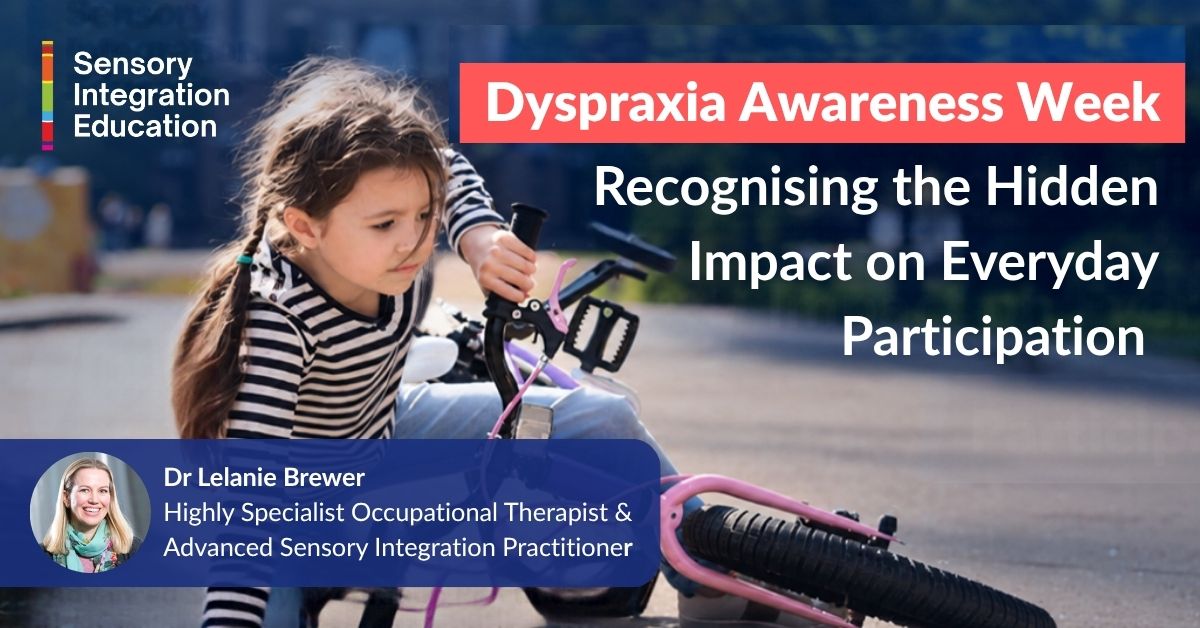
Dyspraxia Awareness Week provides an important opportunity to increase understanding of a condition that can have a significant impact on everyday life, yet is still frequently misunderstood, overlooked or missed.
Dyspraxia, also referred to as Developmental Coordination Disorder (DCD), is a lifelong neurodevelopmental condition that primarily affects motor coordination. However, its impact can extend well beyond movement and coordination, influencing organisation, planning, sequencing, learning, communication, self-care and participation in everyday activities.
One of the challenges in recognising dyspraxia is that it is often not immediately visible. Individuals may develop strategies to compensate for their difficulties, meaning that the considerable effort required to complete everyday tasks may go unnoticed.
More than being “clumsy”
Dyspraxia is sometimes reduced to difficulties with coordination or described simply as being “clumsy”. While motor coordination difficulties are a central feature, this description does not capture the broader impact that dyspraxia can have.
Everyday occupations and activities often require the integration of multiple skills. Getting dressed, preparing a meal, handwriting, using a computer, managing personal belongings, travelling independently or participating in sport can all involve motor planning, sequencing, organisation and sensory processing.
For someone with dyspraxia, these activities may require significantly more concentration and conscious effort. As a result, a person may be able to complete an activity but experience it very differently from someone without these difficulties.
The importance of participation
From a health and social care perspective, it is important to consider not only what a person can do, but how their difficulties affect their participation in meaningful activities. Participation includes involvement in education, employment, family life, relationships, leisure, physical activity and the wider community.
For some people with dyspraxia, the barriers to participation are not immediately apparent. They may avoid particular activities because they are physically demanding, unpredictable or difficult to organise. Others may require considerably more time or energy to complete routine tasks.
This can have a cumulative effect. If getting ready for work requires greater effort, navigating a busy workplace is exhausting and completing tasks takes longer, there may be less energy available for socialising, exercise, family life or leisure. Similarly, a child who finds PE, handwriting or playground activities challenging may begin to withdraw from opportunities that their peers experience as straightforward.
Therefore, the impact of dyspraxia should not be measured solely by whether an individual can complete a task. We also need to consider the effort, time, support and environmental demands associated with participation.
Sensory differences are also important
Another area that can be overlooked is sensory processing. Many people with dyspraxia also experience sensory differences, which may include difficulties with sensory discrimination as well as sensory modulation. Sensory discrimination refers to the ability to accurately identify and interpret sensory information, such as distinguishing between different sounds, textures, movements, visual information or sensations from the body. Difficulties in this area can affect how effectively a person understands and responds to information from their environment and their own body.
Individuals may also find certain sounds, lights, textures, smells, movement or touch particularly difficult to tolerate or process. Busy environments can present multiple demands simultaneously, making it harder to discriminate between relevant and irrelevant sensory information, concentrate, organise information and respond effectively.
For example, a busy classroom, open-plan workplace, shopping centre or public transport environment may create a combination of sensory and motor demands that can be difficult to manage. Difficulties with sensory discrimination may also affect practical activities, such as judging how much force to use, locating an object without relying heavily on vision, identifying where the body is positioned in space, or distinguishing between similar sensory inputs.
Sensory differences can therefore contribute to fatigue, reduced concentration, difficulties with motor planning and coordination, avoidance of particular environments and reduced participation in everyday activities.
Recognising this is important because behaviour can easily be misinterpreted. What may appear to be disengagement, reluctance or poor concentration may instead reflect sensory overload, difficulty discriminating and interpreting sensory information, or the cumulative cognitive and physical demands of the environment.
Moving beyond assumptions
Greater awareness of dyspraxia requires us to look beyond assumptions about capability and motivation. A person who takes longer to complete a task is not necessarily lacking motivation. Someone who avoids a particular activity may not be uninterested. Difficulty with organisation does not mean that someone does not care, and finding a busy environment overwhelming does not mean that a person is antisocial. Instead, we should consider whether the demands of the task or environment are creating unnecessary barriers.
Simple adjustments can make a significant difference. These might include clear and structured instructions, breaking tasks into manageable stages, allowing additional processing or completion time, providing practical demonstrations, reducing unnecessary sensory distractions and offering flexibility in how an activity is completed.
The most appropriate support will, of course, depend on the individual and their specific strengths and needs.
Awareness needs to lead to inclusion
Dyspraxia Awareness Week is not simply about increasing recognition of the condition. It is an opportunity to consider how our environments, expectations and systems can either support or restrict participation.
When dyspraxia is missed or overlooked, individuals may spend years adapting to environments that do not recognise their needs. Earlier recognition and appropriate support can help reduce unnecessary barriers and enable people to participate more fully in the activities that matter to them.
A more informed approach means recognising that ability and participation are not the same thing. Someone may have the ability to complete a task, but if doing so requires disproportionate effort, causes significant fatigue or leads them to withdraw from other meaningful activities, there is an important impact that needs to be understood.
This Dyspraxia Awareness Week, let’s look beyond the visible signs of coordination difficulties and consider the wider experience of living with dyspraxia, including the hidden effort, sensory differences and barriers to participation that can so easily go unnoticed.
Greater awareness can lead to greater understanding. And greater understanding can help create environments in which people with dyspraxia are not simply expected to cope, but are genuinely supported to participate.
Dr Lelanie Brewer
Highly Specialist Occupational Therapist, Advanced Sensory Integration Practitioner, PhD, MScOT, BSc, FHEA
Sensory Integration Education is a leading UK provider of postgraduate and CPD training in sensory integration. Our postgraduate courses are accredited by Sheffield Hallam University.
Check Out Our Upcoming Live Training Events
You can purchase individual events or get access to a whole year of CPD events with a Lifelong Learning Programme subscription.
