
EmphaSIze March 2026: Celebrating Neurodiversity
By Sensory Integration Education, 9th March 2026
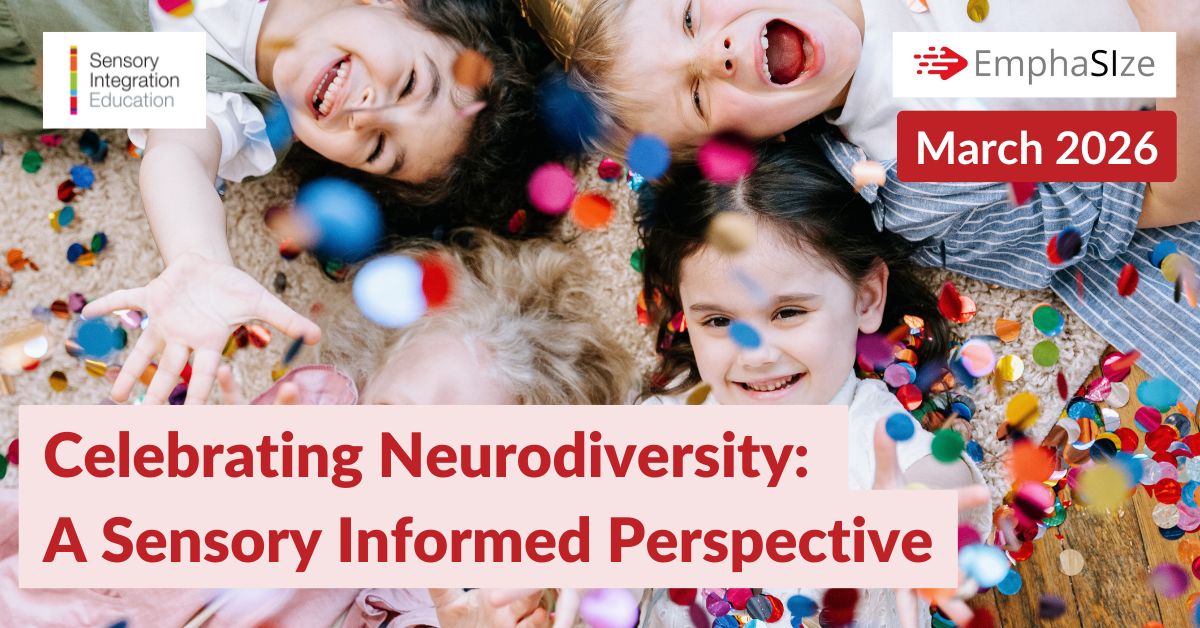
Welcome to the March issue of EmphaSIze! It’s Neurodiversity Celebration Week next week - so this month we're celebrating Neurodiversity from a Sensory-Informed Perspective.
In this issue we've put together useful articles, research, books, and product ideas to help better inform ourselves about neurodiversity so that we can put into practice actions to be more inclusive in our settings when working with clients.
Also if you’re looking to take the next step in your sensory training journey, applications for Module A of our Postgraduate Pathway are still open until 5pm on Friday 20th March. And if you identify as neurodivergent and want to find out what support you can expect if starting your postgraduate journey with us, read the article below ‘How We Help Neurodivergent and Disabled Postgraduate Students Thrive’ to find out more!
News & Features
How We Help Neurodivergent and Disabled Postgraduate Students Thrive
Starting a postgraduate qualification is an exciting and meaningful step in your professional journey. At SIE, we believe that every student should have the opportunity to thrive—not just academically, but as a valued member of a supportive learning community.
We recognise that some of our postgraduate learners are neurodivergent, disabled or managing long-term health conditions alongside their studies. That’s why – in partnership with our academic partner Sheffield Hallam University - we are committed to creating an inclusive, accessible environment where the right adjustments, guidance and encouragement are in place from the very beginning, empowering you to succeed with confidence.
Read our blog to find out more.
Discovering My Sensory Rhythm: An AuDHD Woman's Journey to Self-Understanding

In this powerful and deeply reflective blog, Teodora Byrne – a late-diagnosed AuDHD woman and Sensory Inclusion Facilitator – invites us into her lived experience of discovering her own sensory rhythm.
With honesty and clarity, Teodora challenges fixed sensory models, reframes regulation as relational and rhythmic, and highlights how noise, movement and sensory anchors shape not only access and participation but wellbeing too. Her journey moves beyond self-surveillance towards compassionate self-understanding.
Check out Teodora’s website here.
Finding Joy in Different Ways of Thinking: A Sensory Perspective
In conversations about neurodivergence, the focus so often rests on challenge — distraction, overload, social misunderstanding, burnout. These experiences are real and significant, shaping daily life in profound ways. Yet alongside them exists another quieter truth: the capacity for deep, sustaining joy that can arise from experiencing the world differently.
In her latest blog, Dr Lelanie Brewer explores the sensory dimension of neurodivergence — not to diminish the reality of distress, but to widen the lens. By looking through a sensory perspective, we can start to see how heightened perception, repetition, hyperfocus, and meaningful attachments can offer not just regulation, but genuine pleasure and richness in everyday life.
More EHCPs isn’t the Answer: My Reflections on the Schools White Paper ‘Every Child Achieving and Thriving’ 
Last month, the government released its Schools White Paper, Every Child Achieving and Thriving, and with it came a wave of uncertainty, debate and deeply felt emotion across the SEND community. In this month’s Thoughts from a Therapist blog, Anna Willis reflects on what this paper might mean for the children and families we support and why she believes that simply increasing the number of EHCPs isn’t the answer.
If you’re a therapist working in a school setting, join SIE’s Beth Smithson and Sensory Inclusive Schools on 15th April and be part of the conversation: Listening, Reflecting and Responding: Ayres Sensory Integration in Schools - Consultation Response.
Also see:
6 ways to turn your home into a sensory-friendly space for neurodivergent kids
Paddington could host TfL’s first sensory-friendly “quiet space” for travellers
New sensory room opens in Causeway Hospital’s Emergency Department
Six ways to create an autism-friendly learning environment
New sensory-friendly waiting room will support neurodivergent children
A simple 20-minute activity that may help ADHD children at school
Chronodiversity: A Forgotten Aspect of Neurodiversity
Upcoming Courses and Webinars

We have a number of live webinars that take place throughout the year covering a broad range of SI-related topics. Below is a snapshot of webinars happening in the first few months of 2026 or click here to view a summary of all the upcoming live events.
All these webinars are available to you by signing up to our Lifelong Learning Programme or can be purchased as individual courses:
- Viewing Eating and Drinking Through a Sensory Lens – 23 March 2026
- Advancing Sensory-based OT Through Play, Relationship and Embodiment – 15 April 2026
- Sensory Integration and Deafness – 29 April 2026
- Neurodivergence and the Perimenopause – 12 May 2026
- PANS/PANDA and Sensory Processing - 21 May 2026
SI Research Digest

Below are links to the most popular sensory integration and sensory processing research papers and findings published on our social channels last month:
This new study explored factors underlying Extreme Demand Avoidance (EDA) in autistic children and adolescents, including those with and without Pathological Demand Avoidance (PDA). It was the first to show that heightened sensory reactivity, particularly increased sensory sensitivity and sensory seeking, distinctly characterises autistic young people with PDA. The findings suggest that strong sensory responses may significantly influence both the ability to manage, and the avoidance of, everyday demands. A clearer understanding of these mechanisms can support strengths-based, individualised strategies, including approaches that adapt environmental sensory demands for autistic children with PDA.
This new study compared sensory processing patterns in adults with clinically significant misophonia (n = 60) to age- and gender-matched controls without measurable misophonia traits (n = 60). The findings offer preliminary evidence that sensory over-responsivity (SOR) may be a central characteristic of misophonia, with 80% of individuals in the misophonia group reporting heightened sensitivity in at least one non-auditory sensory domain. Sensitivities related to touch and smell were the most frequently reported.
Sensory-processing informed autism practice for child-centred therapists
Many autistic people experience distinct sensory processing challenges. This new paper explores how ongoing dysregulation of stress and shutdown systems relates to these sensory differences, with particular attention to interoception. After outlining this context, the authors introduce five key areas of clinical practice and conclude by encouraging practitioners to stay flexible and responsive to each child’s individual sensory and communication needs.
Sensory stimuli in the built environment for autistic people: A scoping review
This new scoping review investigated autistic people's sensory experiences and related design considerations for the built environment. Based on the findings the authors propose a Sensory-Inclusive Built Design Framework in order to support the physical and psychological wellbeing of autistic and other neurodivergent people with sensory processing differences.
Resources

Take a look at our books and product recommendations for this month:
Neurodiversity in the Early Years: Practical and Proven Strategies to Enable Neurodivergent Children to Thrive: How we support children in their early years to understand, to be accepted for their unique differences and to thrive, has a life-long impact. With a neuro-affirming, strength-based narrative running throughout, this accessible book will help to improve your knowledge, skillset and practical application of high-quality neuro-inclusive practice.
UNMASKED: The Ultimate Guide to ADHD, Autism and Neurodivergence: Ellie was 24 when she learned she wasn't broken. She wasn't a bad person, she was neurodivergent. Her late diagnosis of ADHD and autism was like a lightbulb being switched on and she could finally start to heal from the trauma of being un-diagnosed and mis-understood for so long.
In this book, Ellie shares what she has learned along her journey. Written in a bite-sized style for whizzy brains like hers, she shares chapters on mental health, how to navigate the workplace and the importance of self-diagnosis so that we can all better understand and celebrate neurodivergence, and ultimately make the world a more inclusive place.
AuDHD Women: Navigating Life After Late Discovery: A Compassionate Guide to Living with Autism and ADHD: This isn’t a clinical textbook but a warm, practical companion for women who have spent years masking, people-pleasing or pushing through burnout. Inside you’ll learn: what Autism + ADHD (AuDHD) really looks like in women; how traits like masking, sensory overwhelm, emotional intensity, and executive dysfunction actually show up day-to-day; the truth about burnout, meltdown cycles, and why rest is not optional; routines and regulation strategies that work with your brain, not against it; parenting with AuDHD; and advocating for yourself in a neurotypical world.
Amazing Me, Amazing You: Written by autism ambassador, Christine McGuinness, this book shows just how important it is to embrace diversity and inclusivity while highlighting just how much it means to accept one another, just as we are with all the uniqueness that makes us special.
This picture book for children aged 3 years upwards, emphasises the importance of empathy and kindness and Christine’s message to parents and carers to help them talk with their children about neurodiversity is the perfect way to introduce the subject to any child.
Gonge Koala: This is a fun and simple resource to improve gross motor skills, balance and coordination. When children sit inside the Koala, they can rock or spin like a carousel. If the Koala is turned upside down, it becomes a small den. Incorporating the balance shell in the classroom it supports the EYFS curriculum, aiding in body strength, balance, coordination and agility. Its versatility allows children to spin, rock, tilt, fall, slide and bounce, essential for developing gross motor skills.
Discounts & Special Offers

Please quote DISCOUNT CODE SIE20 for 10% discount on Southpaw orders up to £100. Orders must be placed by phone on +44 (0) 115 718 0020.
Would you like to receive EmphaSIze: The Sensory Integration Newsletter in your inbox? JOIN SIE FREE TODAY
Best wishes,
Sensory Integration Education
NB: Sensory Integration Education is not responsible for the content on external websites. Sharing a resource does not imply endorsement by Sensory Integration Education.
