
EmphaSIze November 2025: Supporting Adults with Sensory Processing Differences
By Sensory Integration Education, 3rd November 2025
Welcome to the November issue of EmphaSIze! This month we're focusing on Supporting Adults with Sensory Differences.
Sensory processing differences are part of how we all experience and interpret the world around us. For some individuals, sensory information can feel too intense, not noticeable enough, or confusing to interpret. When these differences impact daily life, we often refer to them as sensory processing challenges.
While much of the focus – and many of the strategies available today – centre around supporting children, sensory processing challenges don’t simply disappear with age. Adults can also experience sensory processing differences that affect their everyday lives and these can shift or intensify with stress, environment, or life circumstances.
In this month’s newsletter, we share information, articles and resources to help increase our understanding of sensory processing in adults and explore practical ways to recognise and support their sensory needs.
News & Features
Build Confidence in Adult Sensory Practice — Join Tomorrow’s Live Sensory Spotlight Talk
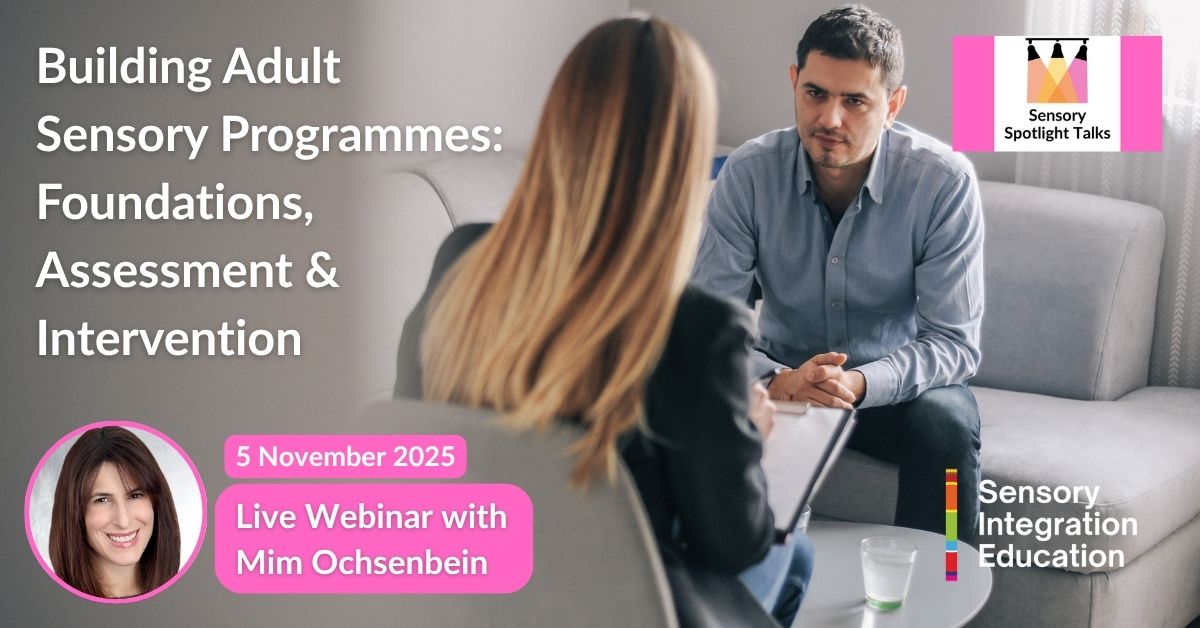
While adults – as well as children - experience sensory processing challenges, structured sensory programmes in adult services are often underdeveloped. That’s why we’re delighted to welcome SIE Honorary Fellow Mim Ochsenbein as our host for tomorrow’s Sensory Spotlight Talk: Introduction to Building Adult Sensory Programmes - Foundations, Assessment and Intervention which aims to bridge that gap.
This live webinar is designed to build confidence and capability for clinicians supporting adults with sensory processing challenges, offering clear frameworks grounded in evidence, practical assessment tools, and adaptable intervention approaches across a range of settings, including community and telehealth.
Perfect for therapists and allied health professionals working in mental health, disability, rehabilitation, and community care — this is an essential opportunity to strengthen best practice in adult sensory programming.
NB Please note this Talk is free to attend for SIE Lifelong Learning members.
Do Sensory Differences Change as We Age?
In this blog, Dr. Lelanie Brewer explores the question of whether sensory differences change as we age. As people grow older, sensory preferences often remain consistent, but individuals adapt by choosing environments and routines that better match their needs.
Dr. Brewer highlights factors such as neurodivergence, hormonal changes and the natural aging process that can all influence how sensory information is processed across the lifespan and the importance of lifelong sensory regulation.
Assessing Sensory Processing Differences in Adults
In this blog we discuss the importance of recognising and assessing sensory integration differences in adults and key evidence-based Sensory Integration assessment tools available for the adult population. These tools help to provide a comprehensive understanding of an individual’s sensory profile, enabling tailored strategies and supports that enhance self-regulation, participation, and overall quality of life.
Managing Sensory Processing Differences as an Adult
This is a throwback to a blog published last year where Dr Lelanie Brewer explores practical ways to manage the daily challenges adults with sensory processing differences can face—from household tasks to parenting and leisure activities.
The blog highlights the importance of making personal choices that support comfort and wellbeing, as well as reminding adults to pace themselves and allow time to recover from sensory overload.
Also see:
Southend Council launches UK's first high street sensory pod
After 40 years as an autistic person in the workplace, I realised it was OK to ask for changes
Autism group's store aims to open up work chances
City of York launches all-age strategy to support autistic people and those with ADHD
Upcoming Courses & Webinars

We have a number of live webinars that take place throughout the year covering a broad range of SI-related topics. Below is a snapshot of webinars happening over the next few months or click here to view a summary of all the upcoming live events.
All these webinars are available to you by signing up to our Lifelong Learning Programme or can be purchased as individual courses:
Throughout December Lifelong Learning members will enjoy replays of popular LLP webinars from earlier this year.
- The Embodied Impact of Developmental Trauma on Praxis – 13 January 2027
- Measuring What Matters: Proof as an Outcome Measure – 11 February 2027
SI Research Digest
Below are links to the most popular sensory integration and sensory processing research papers and findings published on our social channels last month:
This new study examines the relationship between sensory processing, resting-state EEG functional connectivity, and autistic traits in a large sample of adults. The findings indicate that elevated autistic traits are associated with atypical sensory processing and altered functional connectivity across unimodal sensory and multisensory integration networks. Notably, sensory processing patterns statistically accounted for the association between altered connectivity and autistic trait levels and were a stronger predictor of trait variation than resting-state EEG connectivity alone.
Together, these findings support a dimensional account of autism-related characteristics, suggesting that sensory processing differences and the organisation of sensory networks covary with autistic traits across adulthood, including beyond clinically diagnosed autism.
This new scoping review examined the growing literature on interoception-based interventions in children, adolescents and young adults aged 4–23 years. Across nine studies, a range of approaches, including structured interoception curricula, acceptance-based interventions and programmes integrating bodily awareness with other therapeutic components, were associated with promising improvements in emotional and behavioural regulation. Some studies also reported improvements in rated cognitive domains, alongside positive changes in areas such as anxiety, pain, eating and social functioning.
While the evidence base is still developing, these findings highlight the potential of interoception-focused approaches as a valuable avenue for supporting self-regulation and everyday functioning.
The review also identifies important directions for future research: larger controlled studies, more consistent outcome measures, and longer-term follow-up will help clarify how interoceptive awareness may contribute to executive functioning and behavioural regulation.
This new study examines the relationship between sensory processing differences and feeding experiences in autistic children, highlighting the importance of understanding these behaviours within the context of individual sensory needs and preferences.
Drawing on 46 studies, the review found that autistic children were more likely to experience differences in sensory processing and greater challenges around mealtimes, with particularly pronounced differences in tactile processing. A moderate association was also identified between sensory processing and feeding difficulties. These findings reinforce the value of recognising sensory and feeding differences as meaningful aspects of autistic development, supporting more individualised, neuroaffirmative assessment and early support rather than viewing these differences solely as deficits.
This new systematic review and meta-analysis provides further evidence of a significant and robust association between sensory processing (SP) and executive functioning (EF) in children and adolescents with neurodevelopmental disorders and at-risk conditions. Synthesising findings from 30 peer-reviewed studies, the review identified a medium overall effect, with SP measures accounting for a substantial proportion of variance in EF.
The findings also suggest that assessment modality influences the strength of this relationship, with performance-based measures demonstrating stronger associations than questionnaire-based approaches. Collectively, the evidence highlights the interdependence of sensory processing and executive functioning and supports the consideration of both domains within comprehensive assessment and intervention planning.
Resources
Take a look at our books and product recommendations for this month:
Discounts & Special Offers
 Throughout December, we will be running our LLP Winter Webinar Replay Offer! SIE Lifelong Learning members will have the opportunity to watch replays of our most popular webinars from earlier in the year. Details to follow shortly on our socials!
Would you like to receive EmphaSIze: The Sensory Integration Newsletter in your inbox? JOIN SIE FREE TODAY
Best wishes,
Sensory Integration Education
NB: Sensory Integration Education is not responsible for the content on external websites. Sharing a resource does not imply endorsement by Sensory Integration Education.
