
"It's Not Behaviour or Sensory — It's More Often Both": Dr Mim Ochsenbein on the Brain-Body Connection
13 July 2026
SIE's magazine SensorNet has interviewed Dr Mim Ochsenbein, OTD, MSW, OTR/L, an occupational therapist and social worker with nearly three decades of experience in sensory integration and processing. In the interview, Mim reflects on a career that has taken her from school-based practice and early intervention into adolescent mental health, and explains how training in two disciplines changed her understanding of the field.
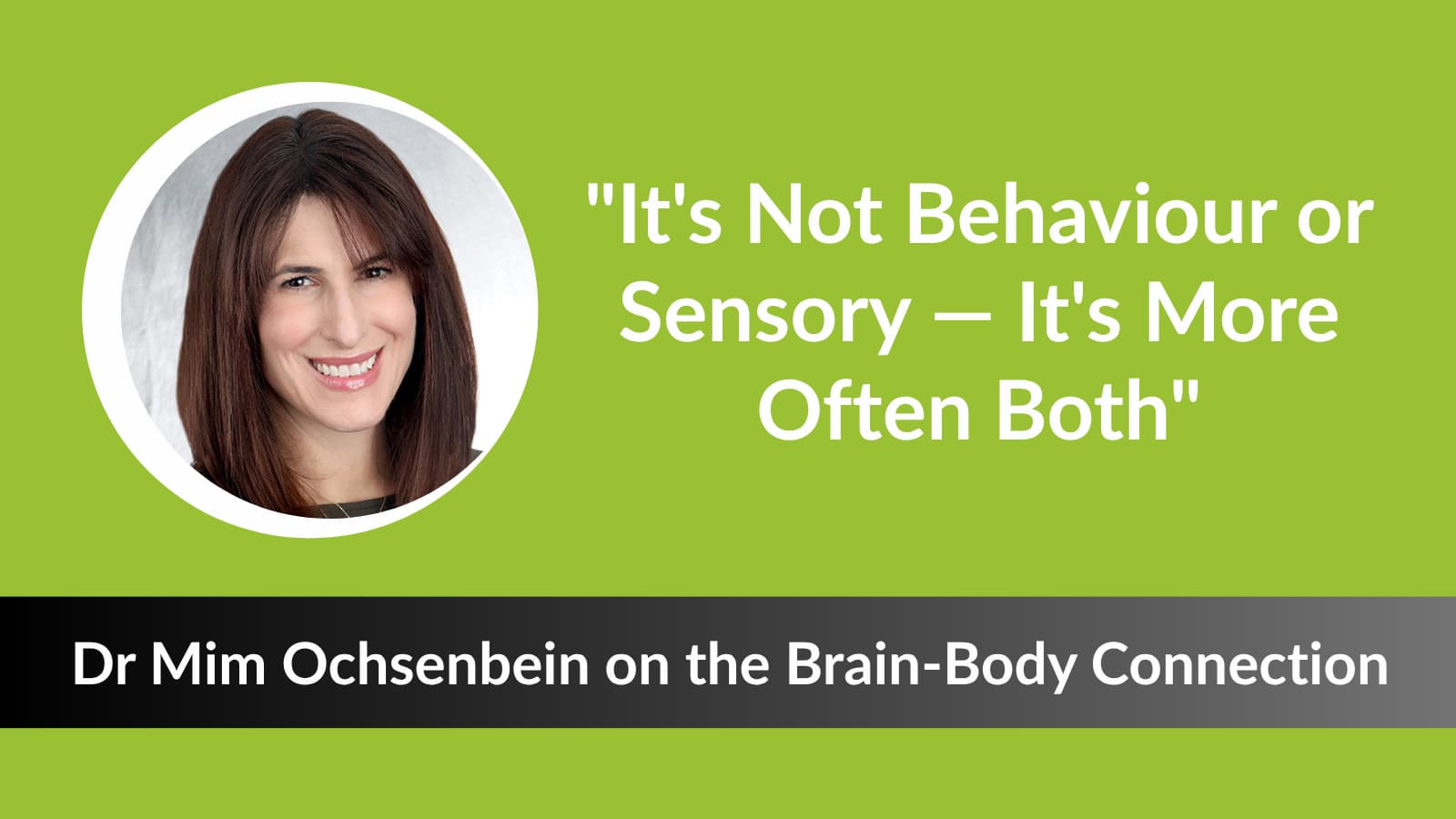
Mim told SensorNet that it was only after training as a social worker, following an earlier career as an occupational therapist, that she began to understand the relevance of sensory integration for populations rarely considered in this context, including schizophrenia, bipolar disorder and borderline personality disorder.
She was also direct about the misconceptions she believes still persist in the profession:
"The first is the idea that everything is about modulation. It's so not! Often it's a lot about discrimination and praxis challenges. Another is the assumption that SI is only relevant for autism, when in fact it is relevant for a wide variety of conditions and expressions — ADHD, CP, learning differences."
Mim added that she would also like clinicians to move away from treating behaviour and sensory processing as separate issues: "It's not behaviour or sensory — it's more often both." Elsewhere in the interview, she explains that behaviours are observable expressions of internal experiences, often reflecting sensory processing directly, and that recognising this connection should be a routine part of clinical reasoning rather than an afterthought.
She also emphasised the importance of distinguishing among compensation, accommodation, and direct intervention, and of understanding what neuroplasticity actually means for how an individual experiences the world and their own body. Mim said this is a conversation worth continuing, particularly given the growing understanding of lived experience among neurodivergent individuals and the wider debate around neurodivergent-affirming practice.
Mim also discussed what she and her colleagues describe as complex discrimination presentations: children who actively seek sensory input, only to become dysregulated once they receive it. She was clear that this is not a registration or modulation issue, but an inability to understand, interpret and experience input at the body level. She compared it to a trickle of information moving through a crack in a dam, building until the dam wall gives and the child becomes flooded.
The interview also touches on her own family. Two of Mim's three children have been identified as twice-exceptional, with differing anxiety conditions and expressions of ADHD. She said this experience has shaped her clinical approach considerably, pushing her towards greater creativity and empathy when standard interventions have not worked as expected.
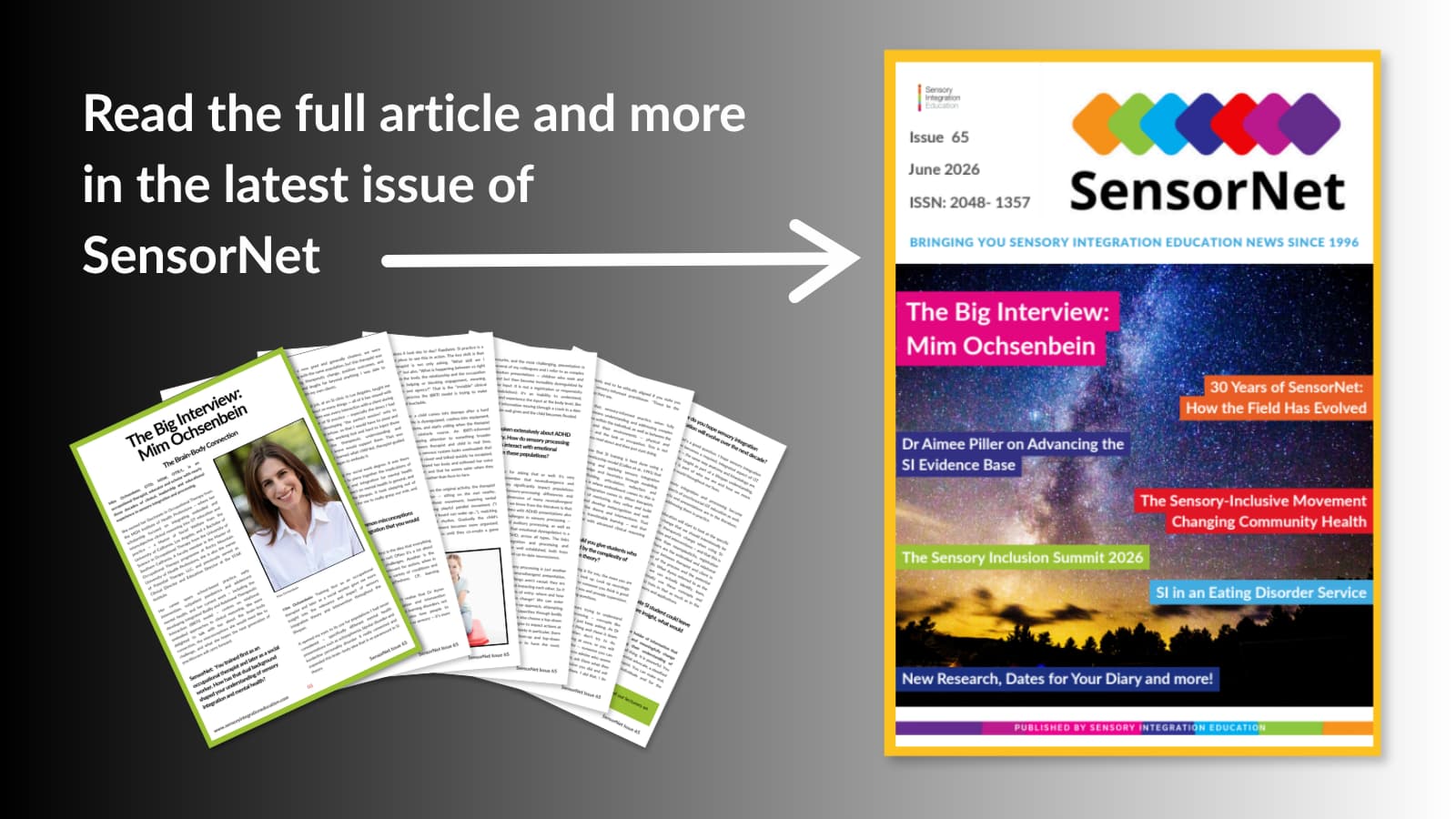
In the full interview, Mim goes into more detail on her developing IBRTI model — Integrated Bodily and Relational Therapeutic Interaction — including a step-by-step account of how it plays out in a session with a dysregulated child. She also reflects on the role of mentorship, the reading that shaped her early career, her advice for students overwhelmed by the complexity of SI theory, and the single insight she hopes every postgraduate student takes into practice.
The full interview is published in SensorNet Issue 65.
Read the full interview
Access to SensorNet is just one benefit of Lifelong Learning Programme membership, which also includes live monthly webinars, a growing suite of on-demand CPD courses, and peer support through the SI Network Community.
Join the Lifelong Learning Programme →
Mim Ochsenbein is one of SIE's lecturers on Module A: Foundations of Sensory Integration.
