
Postgraduate Qualifications in Sensory Integration
Transform your practice. Qualify as a Sensory Integration Practitioner. University-accredited postgraduate training in Ayres Sensory Integration® — in partnership with Sheffield Hallam University.
30+ years • 100,000+ learners • 5-star Trustpilot • 1,700+ reviews
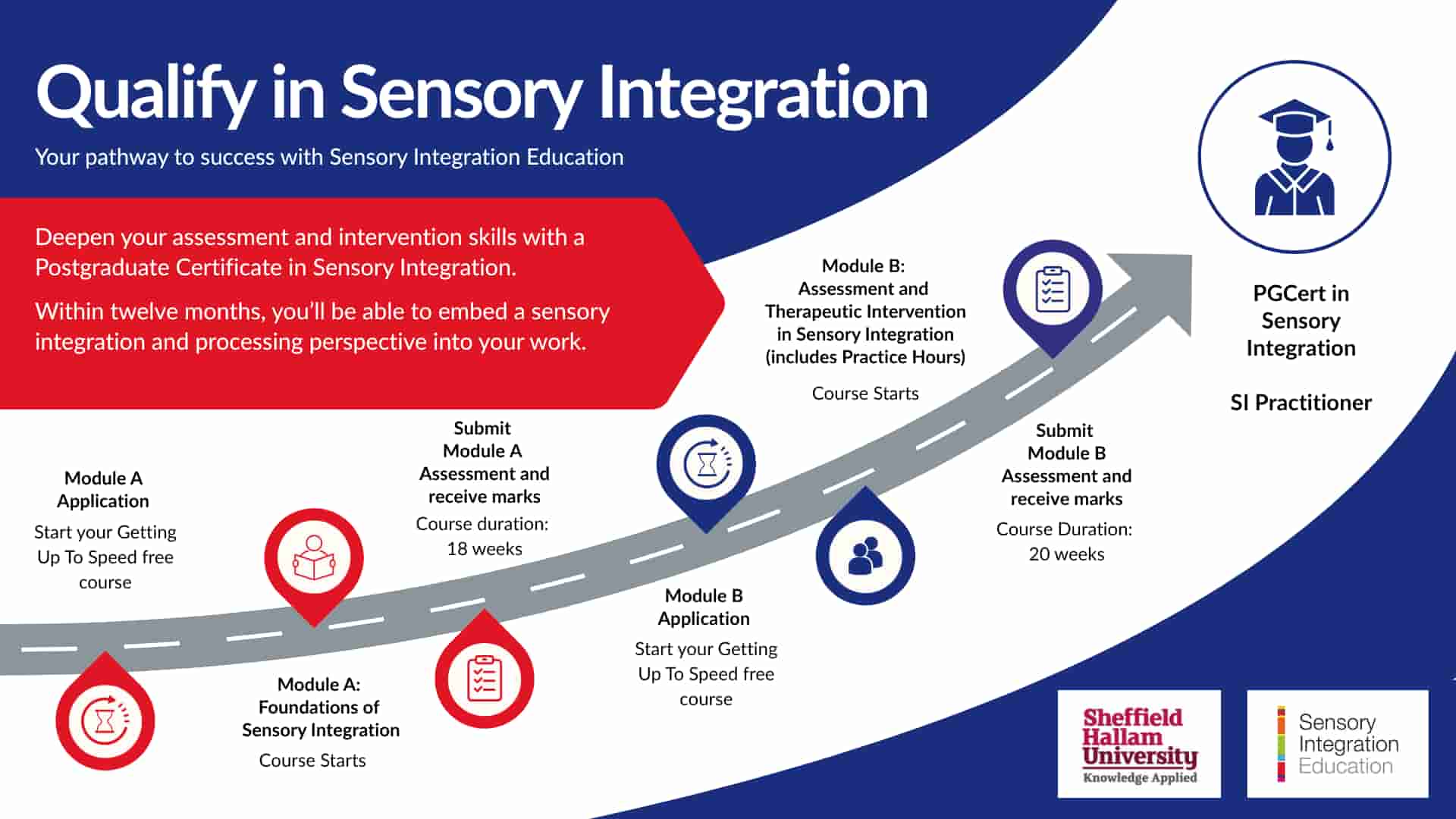
Pick the route that matches your goals. You can study one module at a time - and progress as far as you wish.
Modules A+B
SI Practitioner
Complete within 12 months
Modules A-C
SI Practitioner (Advanced)
Complete within 19 months
Modules A-E
SI Practitioner (Advanced)
Complete within 36 months
Clinical Mentoring: included if you have a workplace mentor.
If you choose an external mentor, budget approx. £50/hr (2 hrs in Module B, 3 hrs in Module C).
Interest-free payment plans available. No VAT to pay (SIE is not VAT registered).

This postgraduate course pathway is for qualified health and care professionals who want to train in sensory integration.
You’ll need:
The right professional qualification and/or registration (depending on the route)
Access to relevant clients in your clinical work
Time and commitment to practise, reflect, and build your skills
Why OTs train in sensory integration
Sensory processing differences can affect everyday activities like dressing, eating, attention, and participation. SI training helps you understand what's contributing to the difficulty and plan support that fits the person and the setting. Without an SI lens, the reasons behind those difficulties can remain unclear, and interventions can miss the mark.
SI training gives you a framework to understand what's actually driving the difficulty — and the clinical tools to do something meaningful about it.
After completing the PGCert, you'll be able to:
Why SLTs train in sensory integration
Communication, feeding, and swallowing don't happen in isolation — they depend on sensory and motor systems working together effectively. When a client processes sensory information differently, it can affect oral motor control, attention, regulation, and the ability to engage in therapy itself. If that's not part of your assessment, you may be missing a significant piece of the picture.
SI training gives you a clinical framework to identify sensory contributions to the presentations you're already working with — and plan intervention that addresses the whole person.
After completing the PGCert, you'll be able to:
Why physiotherapists train in sensory integration
As a physiotherapist, you help people move better and live well. But movement difficulties don't always have a straightforward mechanical cause. Sensory processing affects body awareness, motor planning, balance, and posture — and when you understand it, you can get much closer to what's actually driving a client's physical difficulties, not just what's visible on assessment.
You'll be able to:
Good to know: Physiotherapists can progress through the full pathway — PGCert, PGDip, and MSc — making this a complete route to SI Practitioner (Advanced) status.
Why nurses train in sensory integration
If you work with people who are neurodivergent, have neurological conditions, developmental differences, or mental health needs, sensory processing is often a significant — and overlooked — part of the picture. SI training helps you assess what's happening and respond in ways that reduce distress, improve engagement, and support better outcomes.
You'll be able to:
Good to know: NMC-registered nurses can complete Module A and Module B to achieve a PGCert and SI Practitioner status. They can also complete Module C and gain a PGDip and SI Practitioner (Advanced) status.
Why psychologists train in sensory integration
Sensory processing differences can drive behaviour, affect emotion regulation, disrupt learning, and limit participation — yet they're frequently missed in psychological assessment and formulation. SI training gives you a clearer lens for understanding what's behind the presentation, and practical tools for working more effectively across multidisciplinary teams.
You'll be able to:
Eligibility: HCPC-registered practitioner psychologists can complete Module A and Module B to achieve PGCert and SI Practitioner status. They can also complete Module C and gain a PGDip and SI Practitioner (Advanced) status.
More professions can now join the pathway
Sensory integration training is relevant across a wide range of health, education, and social care roles. If your work brings you into contact with people whose sensory processing differences affect their behaviour, participation, or wellbeing — this training will strengthen what you can do for them.
Current entry routes by profession:
You'll gain:
Learn SI theory and sensory processing patterns. Understand how sensory integration affects participation and function.
(18 weeks)
A short module for those who have completed the original SI Module 1 and now wish to move on to Module B.
Build your assessment skills. Learn how to interpret results, turn them into a clear formulation and plan and deliver interventions.
SI PRACTITIONER
(20 weeks)
Apply SI to more complex presentations and real-world settings.
SI PRACTITIONER (ADVANCED)
(22 weeks)
Develop research literacy, ethics, methodology, and the ability to appraise evidence confidently.
(12 weeks)
Conduct your own research project with structured academic support.
(48 weeks)
Dates, Fees and How to Apply
Our postgraduate pathway is designed for busy clinicians and structured for real-world learning.
You’ll get:
Online access 24/7
Learn in your own time with high-quality teaching resources and clear pacing.
Live teaching and interaction
Sessions and activities designed to help you integrate theory into clinical reasoning.
Supportive learning community
Peer learning, reflective tasks, and shared practice development.
Journal Club
Stay connected, supported, and current - with guided reading and discussion.
Clinical application built in
You’ll be supported to apply learning to your practice (with supervision/mentorship embedded where needed).
| NEW Pathway | |
| Module A, B or C | £1,750 each |
| Module D | £885 |
| Module E | £2,655 |
| Modules A-E | £8,790 in total |
| SIE is not VAT registered | No VAT to Pay |
| * Interest-Free Payment Plans: Modules A, B or C |
5 x monthly payments of £350 |
| Payment Plan for PGCert (A+B) | 10 x monthly payments of £350 |
| Payment Plan for PGCert (A+B+C) | 10 x monthly payments of £525 |
* Payment plans available for self-funding students only. The first instalment is due 15 days after booking.
Discounts: A 5% discount is available for single orders of £10,000 or more.
Potential Additional Cost:
Clinical Mentor Sessions:
You may:
Use a workplace-based clinical mentor at no additional cost, or
Arrange an external clinical mentor (approx. £50 per hour).
We know this training is a big commitment - both time and money. Most people need to plan ahead, line up funding, or spread the cost. You don’t have to work it out on your own.
Many learners are funded by their employer (NHS services, schools, charities, or private practice). We can give you templates to help you ask for support.
If you’re paying yourself, you can spread the cost with interest-free monthly payments.
Payment plans
Modules A, B or C: 5 monthly payments of £350
PGCert (A+B): 10 monthly payments of £350
PGDip (A+B+C): 10 monthly payments of £525
Payment plans are for self-funding learners only. The first payment is due 15 days after booking.
If you plan to complete the full MSc (Modules A–E), you may be able to apply for a UK postgraduate loan (subject to eligibility).
This pathway is built for working clinicians. It’s online and flexible, but you’ll need regular study time each week.
Many learners plan for:
5–6 hours per week (for example, one evening + half a day at the weekend)
Extra time near assignment deadlines
Time to apply learning in practice and reflect on it
Tip: if you’re asking for employer funding, raise study time early. Even a small amount of protected time helps.
To set yourself up well:
Choose a weekly study routine you can stick to
Decide your funding route (employer or self-funding)
Sort support early (study time, case access, mentoring)
Apply early so you can plan properly
Need help choosing the right route?
Book a call and we’ll help you with eligibility, pathway options, and funding planning.
PGCert in SI (Modules A and B) must be completed within 12 months.
PGDip in SI (Modules A, B, and C) must be completed within 19 months.
MSc Advancing Practice in SI (Modules A-E) must be completed within 36 months.
Your eligibility to transfer depends on the Sensory Integration (SI) modules you have already completed:
If you have completed SI Modules 2, 3, or 4, you may continue on the original programme pathway.
If you have completed SI Modules 1 and 2 with us, you can choose to transfer to the new programme and proceed directly to Module B to complete your PGCert in Sensory Integration.
If you have already completed a PGCert in Sensory Integration with us under the original structure (SI Modules 1, 2, and 3), you may progress directly to Module C to work towards your PGDip in Sensory Integration.
If you completed SI Module 1 within the last five years, you can transfer to the new programme by completing a short Bridging Module* before progressing to Module B of the PGCert in Sensory Integration.
* The bridging unit (Fee: £500) is designed to build on your existing learning and ensure you have covered the full range of underpinning theory, clinical reasoning, and practical application taught in Module A. This ensures you enter Module B fully prepared and aligned with other students on the new programme.
SI Module 3 (PGCert) Clinical Reasoning and Practice in Sensory Integration: Intervention →
(19 weeks)
SI Module 4 (PGDip) Advanced Practice →
(16 weeks)
SI Module 5 Researching for Practice →
(12 weeks)
SI Module 6 (MSc) Dissertation →
(48 weeks)
PGCert in SI (SI Modules 1, 2 and 3) must be completed within 24 months.
PGDip in SI (SI Modules 1, 2, 3 and 4) must be completed within 36 months.
MSc Advancing Practice in SI (SI Modules 1-6) must be completed within 48 months.
| ORIGINAL Pathway | |
|
10 Credit Bridging Unit (For Students who have completed SI Module 1 and need to move on to Module B) |
£500 |
| Modules 3 or 4 | £1,200 each |
| Module 5 | £885 |
| Module 6 | £2,655 |
| SIE is not VAT registered | No VAT to Pay |
| * Interest-Free Payment Plans: Modules 3 or 4 | 4 monthly payments of £300 |
* Payment plans available for self-funding students only. The first instalment is due 15 days after booking.
Discounts: A 5% discount is available for single orders of £10,000 or more.
Potential Additional Cost:
Clinical Mentor Sessions:
You may:
Use a workplace-based clinical mentor at no additional cost, or
Arrange an external clinical mentor (approx. £50 per hour).
Use this call to check eligibility, choose the right starting point, and understand time commitment and costs.
Understanding the Qualifications
PGCert (Postgraduate Certificate) is the first level of postgraduate study. Complete Modules A and B to earn 80 academic credits and the title of SI Practitioner.
PGDip (Postgraduate Diploma) goes further. Complete Module C to reach 120 credits and SI Practitioner (Advanced) status.
MSc (Master of Science) is the full qualification. Add Modules D and E — including a research dissertation — to achieve Masters-level recognition.
All awards are accredited by Sheffield Hallam University and internationally recognised. You can study one module at a time and stop at any level.
All modules in our postgraduate pathway are accredited by Sheffield Hallam University, a UK government-recognised institution. This means an independent body has formally reviewed and approved the course against national academic and professional standards — not just self-certified.
That gives confidence to you, your clients, and your employer that your qualification meets the required standard.
Yes. Each module earns academic credits recognised by Sheffield Hallam University.
UK university credits are internationally recognised and transferable.
Yes. You can book and complete modules one at a time, and decide how far you want to progress as you go. Many learners start with Module A to build foundations and assess whether postgraduate study is right for them before committing to the full PGCert or beyond. There's no obligation to continue past any module.
Eligibility and Entry
The pathway is open to a range of registered health and care professionals. Current entry routes by profession:
Sensory integration is not a stand-alone therapy. It's one of many approaches that health and social care professionals use after fully assessing a person's needs. To do this safely, practitioners need to understand the whole picture of someone's health, development, and social circumstances.
Without this wider knowledge, there's a risk of misunderstanding behaviours, raising false expectations, or missing important information about a person's wellbeing. That's why our course is open only to registered professionals — their background training gives them what they need to use SI safely and effectively.
If you've studied SI before — with us or elsewhere — Sheffield Hallam University may be able to recognise that learning toward your award. Speak to our education team before applying to explore whether RPL applies to you.
Your eligibility to transfer depends on the SI modules you have already completed:
Study Format and Workload
Yes — the pathway is designed for working clinicians. All teaching is delivered asynchronously, so you study at times that suit you. Most learners plan for around 5–6 hours per week, for example one evening plus half a day at the weekend, with some extra time near assignment deadlines.
If you're asking your employer for funded study time, we'd recommend raising it early. Even a small amount of protected time each week makes a significant difference.
Each module (A, B and C) includes written assignments of approximately 4,000 words, involving critical analysis, reflection, and application to your own clinical practice. You'll also need to complete practice hours and wider reading alongside the taught content.
It's Masters-level study, so the expectation is genuine academic rigour — but the content is directly relevant to your day-to-day work, which most learners find makes it more manageable.
You'll have access to a range of support throughout your studies, including:
You're not studying alone — the course is designed to keep you connected and supported at every stage.
You'll have 12 months' access to course content from your start date. This covers the full duration of each module, with time to complete assignments and wider reading.
Sheffield Hallam University's standard postgraduate regulations apply. You'll normally have the opportunity to resubmit a failed assignment. Our tutors provide detailed feedback to help you understand what's needed, and you'll have support throughout the process.
If you're concerned about a specific situation, contact our education team to discuss it before it becomes a problem.
Unfortunately not — bookings close on the published deadline and we can't make exceptions. We recommend applying early, particularly if you need employer funding approved first.
Clinical Requirements
Essential Information for Prospective Applicants
Our Sensory Integration Module B combines academic learning with opportunities to apply theory in real-world practice. To support your development as an ethical, reflective, and evidence-informed practitioner, the module includes 20 hours of independent clinical experience and 2 hours of clinical mentoring with a Practitioner who has completed SI training to the level of Module 4/Module C.
What are the practice hours?
Your 20 practice hours are self-directed and completed within your own workplace or professional context. During these hours, you will explore how sensory processing and integration differences can influence participation and begin applying SI reasoning to real individuals.
You will need in-person, face-to-face access to at least one individual who presents with sensory processing and integration differences. If SI is not relevant to your client group, you may struggle to complete the applied elements of the module.
Your hours can be split across several individuals and may include observing a professional with postgraduate training in SI, gathering and interpreting assessment information, conducting structured clinical observations, analysing sensory-related participation challenges, supporting families or colleagues to understand an individual's sensory needs, developing participation-focused goals, and reflecting on your reasoning and decision-making.
You do not need access to published standardised assessments, specialist equipment, a dedicated SI treatment space, or specific assessment kits. The core aim is to develop skilled observation, thoughtful interpretation, and the ability to link sensory processing to participation — skills that can be built through non-standardised assessments, structured observations, and real-world practice.
Is sensory integration relevant to your client group?
SI approaches are most meaningful when you work with individuals who experience sensory processing and integration differences that affect daily life — for example in autism services, learning disability services, paediatrics, DCD, trauma-informed practice, mental health, or neurological rehabilitation.
SI will be less relevant in roles focused on musculoskeletal conditions, acute medical care, equipment provision, short-term non-neurological presentations, or client groups whose difficulties are unrelated to sensory processing. If your setting does not routinely involve sensory integration needs, you may find it difficult to complete the practice hours.
What is clinical mentoring?
You are required to complete two hours of clinical mentoring with a practitioner who has completed our Advanced Practice Module (Module C/4). Mentoring is designed to support your SI practice, strengthen reflective skills, and help you bridge theory and practice.
You arrange and pay for mentoring independently — fees are agreed directly with your mentor and are separate from the module cost. Mentoring can take place online or in person. You may choose a suitable practitioner within your workplace or a mentor from the SIE Register of Clinical Mentors.
A clinical mentor is required for Modules B and C. If you have a colleague in your workplace who is a qualified SI Practitioner, they can mentor you at no additional cost. If not, you'll need to arrange an external mentor — typically around £50 per hour, with approximately 2 hours needed for Module B and 3 hours for Module C.
Not sure how to find a mentor? Our education team can advise.
Yes. While much of the SI evidence base comes from paediatric research, the principles apply across the lifespan. The course equips you to extrapolate and apply SI frameworks to adult populations — including those with neurological conditions, mental health needs, learning disabilities, and acquired difficulties. Many of our graduates work exclusively with adults.
Fees and Funding
New Pathway fees (Modules A–E):
SIE is not VAT registered — no VAT to pay on any of our fees.
Yes, for self-funding students:
Payment plans are for self-funding learners only. The first payment is due 15 days after booking.
Many learners are funded by their employer — NHS services, schools, charities, or private practice. We have templates to help you make the case to your employer or NHS trust.
If you plan to complete the full MSc (Modules A–E), you may be able to apply for a UK postgraduate loan, subject to eligibility.
Administration
ICEASI is a voluntary membership body, not a regulator, and there's no requirement to hold an ICEASI-recognised qualification to practise Ayres Sensory Integration.
We've chosen not to take part in its recognition process, as our pathway is built around clinical learning outcomes assessed to UK university standards. Your qualification is accredited by Sheffield Hallam University and leads to a recognised UK postgraduate award (PGCert/PGDip/MSc) plus SI Practitioner or Advanced SI Practitioner status.
We're committed to supporting disabled students and those with additional needs. Find out what support is available and how to request it.
If you need a replacement module certificate, you can request one using the link below.
Confidence, Clinical Reasoning, and Real-World Impact
%20Transform%20Your%20Practice%20With%20Sensory%20Integration%20A%20Free%20Course%20for%20Therapists.png)
Free one-hour introduction to Ayres Sensory Integration for OTs, SLTs, physios, and other health professionals. Understand what ASI is, hear from Advanced Practitioners on how it shaped their work, and take away four practical strategies for clients.
Free

Free guide for Occupational Therapists on the impact that sensory integration training will have on their career and practice.
Free

Use this template to request NHS funding for your Postgraduate Sensory Integration Training. Copy and amend as appropriate - we've filled in the key details for you!
Free

Easily customise this template to request full or part funding from your employer for your postgraduate training in sensory integration. Secure the support you need for your professional growth!
Free